


Truly Human Leadership: How Caring for People Drives Engagement, Productivity, and Performance.
Related Insights
Ask any business leader what they want from their team, and you'll hear: engagement, productivity, accountability, innovation, results.
Ask any employee what they want from their leader, and you'll hear: trust, growth, respect, care, someone who sees them as more than a number.
Herein lies the problem: most organizations treat these as competing priorities.
But what if the best results come from leaders who refuse to choose?
How We Lead Impacts How We Live
People and performance aren’t opposing forces – they're inseparable. Truly Human Leadership means caring for people in ways that unlock their full potential: treating them with dignity, challenging them to grow, and holding them accountable because you believe in what they can become. This isn't choosing between people or results. It's recognizing that human flourishing and business performance are the same work.
We can see this demonstrated in leadership behaviors time and time again.
The leader who micromanages doesn't just slow down a project – they erode someone's confidence. The leader who dismisses feedback doesn't just miss an opportunity to improve – they teach someone their voice doesn't matter. The leader who only measures sales targets doesn't just miss the whole picture – they signal that people are only as valuable as last quarter's numbers.
And the opposite is also true.
The leader who genuinely cares for their people – who checks in without an agenda, who knows what matters to them outside the office, who asks for feedback and actually acts on it – doesn't just create a nice workplace. They unlock engagement, productivity, and performance that no incentive structure or performance management system can manufacture.
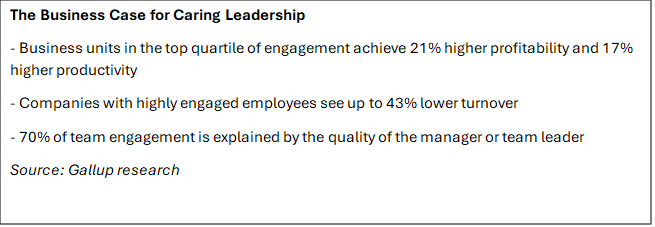
This is what we mean by Truly Human Leadership: caring for your team the way you'd want someone to care for the people you love, not as a feel-good philosophy, but as the foundation for the results every business needs.
What Truly Human Leaders Do Differently
What do your people do when they leave? Not when they leave your company, but when they leave the office each day.
Knowing what someone cares about outside of work will tell you more about their purpose than anything they do inside your four walls. And knowing someone's purpose is how you unlock their potential.
Truly Human Leaders don't just know job titles and performance ratings. They know what lights people up. What is hard right now. What they are working toward. And they use that knowledge strategically – aligning people's strengths and passions with what the team needs, challenging them in ways that help them grow, supporting them through difficulty.
This kind of care drives engagement. It builds trust. It allows you to tap into abilities and motivation that formal processes miss entirely.
When you genuinely care about the whole person, not just the employee, you create workplaces where people don't just perform. They thrive. In Everybody Matters, Bob Chapman defines Truly Human Leadership as ‘sending people home safe, healthy, and fulfilled.’ That’s the standard – and when leaders meet it, thriving people drive thriving businesses.
Creating the Conditions for Truly Human Leadership
If Truly Human Leadership is so critical, why don't more organizations have it?
Here's what we see happen over and over: Organizations promote their very best doers into leadership roles. These are talented, high-performing people who have mastered their craft. And then overnight, their job fundamentally changes.
They're no longer responsible for their own results – they’re responsible for unlocking the potential of an entire team. They're no longer rewarded for individual excellence – they're evaluated on how well they develop others. But often, no one actually teaches them how to make that shift.
Leadership development is critical. And it's not enough.
You can send your managers to a powerful leadership workshop. They can leave inspired, equipped with new tools, ready to lead differently. And then they return to an organization where promotions are still based solely on individual performance, performance reviews still focus only on quarterly targets, the manager who gets results at any cost is still celebrated, and hiring still screens for technical skills without asking if someone aligns with your values.
When your systems reinforce one set of behaviors while your training teaches another, your leaders become the only ones holding the line. And that's unsustainable.
Truly Human Leadership requires aligning every touchpoint of the employee lifecycle – not just the training room:
- Hiring: Screen for people who demonstrate care for others, not just technical excellence
- Onboarding: Teach your values from day one, so leaders aren't starting from scratch with every new team member
- Performance evaluation: Measure both results and how people embody your values and build relationships
- Promotion: Assess leadership capability, not just individual performance
- Recognition: Celebrate leaders who develop people while driving performance, not just those who hit targets
What gets measured gets moved. If you only measure what fits in a spreadsheet, you'll only develop spreadsheet-level leaders.
Leadership development teaches leaders how to care for people while driving results. But your systems determine whether they actually can.
Taking Action
If you're ready to develop Truly Human Leadership in your organization, here are three places to start:
As a team: Know your people. Block time this week to check in with each person on your team with no agenda. Ask what they care about outside of work. Ask how they're really doing. Listen. The simplest and most powerful thing a truly human leader does is genuinely care – and you can start today.
As a leader: Ask for feedback. Your team knows where you rank as a truly human leader, even if you don't. Ask them: "How well do I care for you as a person? What's one thing I could do to support your growth better?" Then do something about it. The fastest way to erode trust is to ask for feedback and ignore it.
As an organization: Audit your systems. At your next leadership meeting, ask: "What do we actually measure and reward when it comes to leadership? Do our promotion, performance review, and recognition practices reinforce care and accountability – or just results?" Then identify one place where your systems contradict the leadership behaviors you want, and fix it.
Share This Article
Meet the Author

Jami Dix,
Senior Consultant
Jami plays a dynamic role leading people, facilitating and developing new content, most recently on diversity and inclusion.
Learn More
Morgan Miller,
Senior Consultant
Morgan is passionate about driving operational efficiency through effective organizational behavior and enjoys critically examining the intersection of business strategy and intentional people leadership.
Learn More